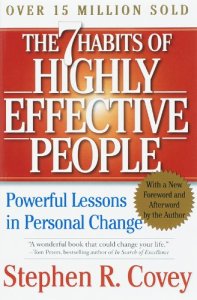
by Stephen Covey
9*/10
Key Ideas:
It is not what others do or even our mistakes that hurt us the most; it is our response.
Trust makes everything easier. To build it, make “deposits” in the emotional bank account.
Balance producing results with renewal – sleep, exercise, meditate, eat well.
Other interesting notes:
Six major deposits to build trust:
- Understand the individual: you need to understand what constitutes a “deposit” to the other person. What are their interests and priorities?
- Attend to the little things: little kindnesses and courtesies are so important
- Keep commitments: cultivate the habit of always keeping the promises you make
- Clarify expectations: the cause of almost all relationship difficulties is rooted in conflicting or ambiguous expectations around roles and goals
- Show personal integrity: integrity is conforming reality to our words – in other words, keeping promises and fulfilling expectations. be loyal to those not present. In doing so, we build the trust of those who are present
- Apologize sincerely when you make a withdrawal: sincere apologies make deposits; repeated apologies interpreted as insincere make withdrawals
Focus on the things that you can actually do something about.
If you want to have a happy marriage, be the kind of person who generates positive energy.
Reactive people use language to absolve themselves of responsibility.
Think how you would like your loved ones to remember you in your funeral.
Define your values.
Focus your time on important/non-urgent activities (quadrant II).
What one thing could you do regularly, that you aren’t currently doing, that would improve your personal/work life?
To say “Yes” to quadrant II means saying “No” to other activities, sometimes even things that appear to be urgent.
Think effectiveness with people and efficiency with things.
Private victories precede public victories. Self-mastery and self-discipline are the foundation of good relationships with others.
You need to invest more than you withdraw from the “Emotional Bank Account” to have productive relationships. This is even more important with people you interact with more frequently than others.
If you can’t reach a true Win/Win, you’re very often better off to go for No Deal.
Seek to understand first, before making yourself understood.
Communicating clearly is essential for your overall effectiveness, as it’s the most important skill you can train. While you spend years learning to read, write, and speak, little focus is given to training the skill of listening.
Combine the strengths of people through positive teamwork, so as to achieve goals that no one could have done alone.
Effective living requires balance between producing results and maintaining production capacity (the golden egg and the goose).
Our character is a composite of our habits.
Thoughts on the book:
*10/10 when it came out. Has been copied and improved on by every personal development book in 30 years, but still holds up. (the time management system is outdated, and for renewal there are better sources). Still, read a proper summary (below) and/or buy and read the whole thing. It is kind of long and some chapters are slow, just skip to next chapter as every single one will have life changing stuff.
Longer summary/notes: TylerDeVries surprisingly, almost all summaries online are terrible, this one is great
If you like this, you’ll probably like: Navalmanack, Principles, Atomic habits, Getting to yes, Just listen, How to win friends and influence people, books
 Leo :)